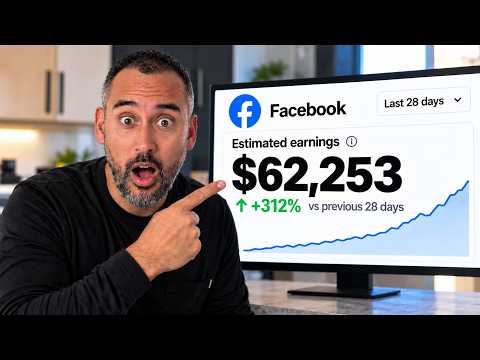
This Facebook Page Made $47,000 in ONE Month Posting Images
Published
Should I watch this?
Skip to the real contentYour full summary is ready below. Read on while we finish your watch recommendation.
Your summary is ready. The watch recommendation is next.
Worth watchingSkim
The post-remixing workflow and affiliate-link setup offer practical detail, but lengthy Content OS tweaking dominates, with little guidance on monetization eligibility and no demonstration that beginners can reproduce the $47,000 month.
The main answer
The proposed method is to build a high-volume Facebook page and earn through both Facebook payouts and affiliate sales—not a demonstrated guarantee of $47,000 a month. 1. Choose a niche and study successful, active Facebook pages. 2. Use Content OS to rewrite their popular posts, recreate graphics, and add your branding. 3. Publish roughly 15–20 times daily, compare performance, and repeat successful formats. 4. Earn from qualifying content through Facebook monetization, if eligible. 5. Add occasional promotional posts and links in your bio or comments to sell your products or earn affiliate commissions. The useful principle is testing content that interests an audience. Simply repackaging viral posts does not establish that you will reproduce their reach or revenue.
Key takeaways
- The headline earnings belong to Jeff Rose’s page, called “Good Financial Sense” in the transcript—not the creator’s experiment. The amount changes from $47,000 to $48,000, and the transcript does not establish its accuracy or revenue breakdown.
- The creator’s own reported examples earned $0.80 and $0.27. At the illustrated $0.30 per 1,000 qualified views, earning $47,000 solely from those payouts would require approximately 157 million qualified views.
- One payout calculation conflicts with the narration: $0.27 from 4,354 qualified views implies approximately 6.2 cents per 1,000 views, not the stated 0.7 cents. This could be a speaking or transcription error.
- The creator already has approximately 196,000 followers. His experiment therefore does not demonstrate what a beginner starting without an audience should expect.
- Posting frequency is presented as a recipe for success, but no controlled evidence supports it. Monetization eligibility, costs, workload, and sustainable results are not adequately explained.
- Rewriting someone’s post and replacing their identity does not automatically resolve copyright, attribution, or platform-originality concerns. Copying audience comments adds authenticity concerns, and factual claims still need independent checking.
Summary
This is a tutorial on mass-producing Facebook content and monetizing its audience. It demonstrates a content-remixing workflow, but provides much weaker support for the headline income claim or the suggestion that beginners can readily duplicate that success.
What’s being promoted?
Content OS is the central promoted product. It offers AI rewriting, caption variations, image generation, templates, and personal branding. The demonstration also requires manual editing and layout fixes; it establishes functionality, not profitability. The commercial agenda is fairly clear: a large earnings hook leads into an extended product demonstration and repeated invitations to a “limited-time” seven-day free trial. Statements such as “we’re adding more options weekly” suggest the creator is involved with the product, but the transcript does not establish ownership, sponsorship, or affiliate compensation. Pricing and post-trial billing terms are not explained. Requests for comments, subscriptions, and a follow-up video also build his audience. Facebook and the named pages serve mainly as the platform and examples, not demonstrated sponsors. The tutorial can contain useful advice while simultaneously functioning as a sales funnel.