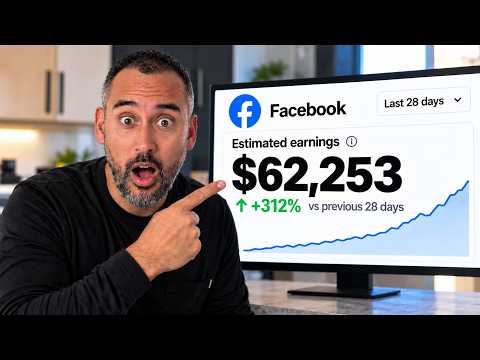
How I Make $1,024,937 In 90 Days Posting Facebook Reels (Full System)
Published
Should I watch this?
Skip to the real contentYour full summary is ready below. Read on while we finish your watch recommendation.
Your summary is ready. The watch recommendation is next.
Worth watchingSkim
Skim for the script structure and CapCut steps for syncing images, narration, and captions; repeated pitches and basic setup add padding, while the promised US-audience targeting and path to comparable earnings are not demonstrated.
The main answer
The proposed method is to build a niche Facebook page and publish large numbers of AI-assisted motivational Reels, then earn through Facebook’s content monetization program if accepted. 1. Create a creator page with a clear niche, relevant keywords in its name and bio, and suitable branding. 2. Generate emotional video ideas and scripts using this structure: attention-grabbing hook → message → memorable metaphor → looping conclusion. 3. Generate matching images and prepare a voiceover. In CapCut, synchronize images to narration, remove awkward pauses, and add captions, music, and light effects. 4. Publish publicly with relevant titles and tags. The creator recommends at least three posts daily and organic growth rather than relying on ads. 5. Seek monetization through the invitation-based program shown in the video. This is a production workflow—not a demonstrated formula for earning $49,000 a month. The transcript does not establish that copying it will produce comparable reach, a US audience, or monetization approval.
Key takeaways
- The central content strategy is emotionally resonant, shareable self-improvement material. AI speeds up production, but the creator also recommends manually improving names, titles, scripts, and editing.
- The creator claims monthly earnings of approximately $49,000, $37,000, and $43,000 on the featured page. The transcript cannot authenticate the narrated dashboard figures, and they do not establish net profit after costs.
- Results are selectively presented: the creator explicitly chooses the highest-earning page. There is no complete account of failed pages, growth timelines, expenses, or typical beginner results.
- The suggested 5,000 followers and 60,000 minutes viewed are personal estimates, not documented eligibility thresholds. The claim that serious beginners should reach them within a month is likewise unsupported.
- Despite promising a predominantly US audience, the tutorial provides no clear, validated targeting method. Naming a page with keywords does not establish where its audience will come from.
- vidIQ search figures do not establish Facebook search demand. Claims about keyword-heavy names, export filenames, and Meta AI discovery producing substantial growth are not demonstrated.
- The assertion that Facebook does not care whether people finish watching is overly absolute and unsupported here. The transcript offers no evidence that engagement alone or posting more is sufficient for distribution.
- Important gaps remain: voiceover creation is skipped, monetization-policy requirements are not meaningfully explained, and manually assembling AI assets does not by itself establish exemption from AI disclosure requirements.
Summary
The video teaches a repeatable AI-assisted workflow for producing motivational Facebook Reels at high volume. Its practical editing instructions are more concrete than its growth and earnings claims. Treat the revenue figures as unverified individual results, not an expected outcome or proof that the demonstrated format qualifies for monetization.
What’s being promoted?
Abacus AI receives the strongest product promotion. The creator repeatedly demonstrates it, compares it favorably with ChatGPT and Claude, claims a $10 price, and advertises a 30% discount through the description link. These are the creator’s pricing and capability claims, not independently verified facts. He says, “I've not been paid to promote this.” A discount link could still involve referral benefits, but the transcript establishes neither affiliate compensation nor undisclosed sponsorship. vidIQ is promoted as the keyword-research tool, with a description link and repeated demonstrations. Any commercial relationship is unknown. Its role also helps make the broader method appear data-backed, although the demonstrated numbers do not validate Facebook-specific demand. The creator’s prompt pack is a direct promotional offer: viewers enter an amount, including zero, complete a checkout, and provide an email address. This permits voluntary payments and potentially builds a marketing contact list. “It won't be free forever” adds urgency; “sharing my secret for free” encourages reciprocity. The transcript does not show whether emails are subsequently used for marketing or whether further paid offers exist. CapCut and Google Docs are demonstrated as workflow tools. Their inclusion alone is weak evidence of sponsorship. Facebook itself is enthusiastically promoted as an earning opportunity, but no relationship with Meta is disclosed or established. The clearest additional agenda is growing the creator’s own audience and directing viewers toward linked resources. Repeated subscription requests, instructions to rewatch, and the closing pitch for a video claiming $400,000 from YouTube Shorts support that reading. Large income claims provide social proof, while framing success around seriousness and avoiding laziness downplays other constraints. These are recognizable marketing tactics, but they do not establish deception or prove the earnings are false.