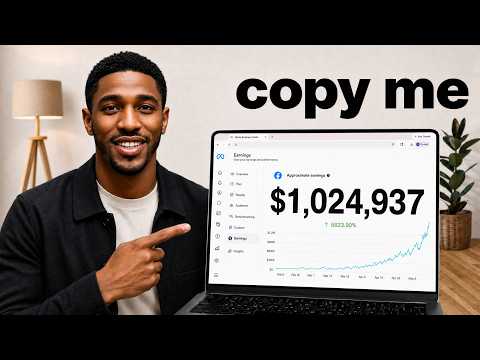
I Made $62,253 in ONE Month Posting Images on Facebook
Published
Should I watch this?
Skip to the real contentYour full summary is ready below. Read on while we finish your watch recommendation.
Your summary is ready. The watch recommendation is next.
Worth watchingSkim
The text-versus-image earnings comparison and competitor-research demos are useful, but recycling advice becomes repetitive, and the $62,253 hook combines Facebook and Instagram revenue without explaining how beginners qualify for monetization.
The main answer
The creator’s method is to find successful ideas in his finance/wealth niche, adapt them into simple images or text posts, publish them to Facebook and Instagram, and repeatedly reuse winning concepts with different formats, backgrounds, or captions. He uses Canva and ChatGPT for creation, PostPlanner for scheduling, and other accounts’ engagement data for research. The key correction: the claimed $62,253 month combines approximately $53,272 from Facebook with roughly $9,000 from Instagram—not $62,253 from Facebook alone. These are reported platform earnings, not demonstrated net profit. The video explains how he scales an already-monetized account, not how a beginner qualifies for monetization.
Key takeaways
- His reported Facebook revenue came predominantly from photos: approximately $47,000, versus $4,000 from text posts and $1,000 from reels. That reflects his account’s results, not a universal ranking of formats.
- The three featured posts reportedly earned just under $900 from nearly 10 million views, over $930 from 4.2 million views, and over $2,500 from 13.5 million views.
- Test the same concept in different formats. In one example, a plain text version substantially outperformed an image version.
- Reuse successful ideas rather than constantly inventing new ones. His examples also show diminishing returns: one repeatedly published concept eventually received much less engagement.
- Views and engagement do not produce predictable payouts. His suggestion that Facebook lowers rates when posts become extremely viral is speculation, not an established explanation.
- The three examples total roughly $4,300—about 8% of his reported Facebook earnings. They illustrate individual successes but do not fully explain the monthly total, publishing volume, costs, or workload.
- Important gaps remain: monetization eligibility, starting audience size, typical beginner outcomes, and originality/copyright considerations. The transcript also omits the actual winning headlines and post text shown onscreen.
Summary
This is a case study in monetizing high-volume, repeatedly tested social content. Its most useful lesson is to study audience response and reuse proven ideas across formats and platforms. Its large income claim is account-specific, combines two platforms, and cannot be independently verified from the transcript.
What’s being promoted?
The clearest commercial pitch is his own course, Get Paid to Post. After establishing credibility with earnings claims and successful examples, he offers the course as a time-saving, over-the-shoulder shortcut. He references satisfied students but supplies no independently verifiable student outcomes, pricing, or evidence of typical results. He does explicitly say purchasing is optional and points to free resources. PostPlanner receives substantial promotion: repeated mentions, a scheduling and research demonstration, and the claim that he could not maintain his publishing volume without it. Post Snag also receives an extended demonstration as a Chrome extension for researching personal profiles, although he acknowledges the tedious scrolling involved. These endorsements could reflect genuine workflow preferences; the transcript does not disclose whether sponsorships, affiliate commissions, or other financial relationships exist. Canva, ChatGPT, and Claude are supporting tool recommendations rather than equally developed sales pitches. Facebook and Instagram are presented as lucrative publishing platforms, but no platform sponsorship is established. Beyond teaching, the video clearly serves to sell his course and build his audience and authority. The large-income hook, selected success stories, tool demonstrations, and closing course offer support that reading. This does not establish deception or fabricated earnings; it does mean viewers are seeing a marketing-oriented success story rather than a balanced estimate of what most beginners should expect.