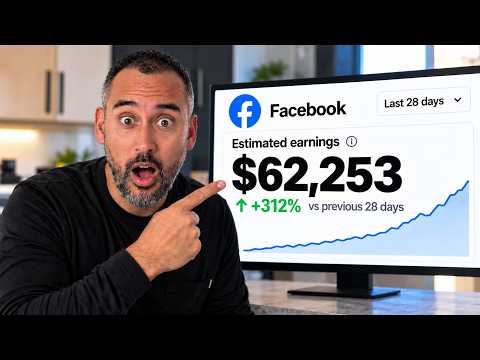
How I Make $120,642.83/month Posting AI Videos On YouTube (Full System)
Published
Should I watch this?
Skip to the real contentYour full summary is ready below. Read on while we finish your watch recommendation.
Your summary is ready. The watch recommendation is next.
Worth watchingYes
Provides a substantive walkthrough of finding outlier topics, organizing ideas, drafting scripts and producing videos in Vsub, though the earnings claims are unproven and asking AI to check itself is not reliable fact-checking.
The main answer
The creator’s proposed system is to build an AI-assisted educational YouTube channel: find promising topics, generate and review scripts, automate video production, then publish consistently. The practical core is researching videos that substantially outperform a small channel’s usual results and making a better, original treatment of that topic. The workflow uses vidIQ for topic research, Claude or ChatGPT for scripts and descriptions, Canva for branding, and paid Vsub for video generation. The creator recommends keeping a spreadsheet of ideas, checking factual claims, and improving storytelling rather than merely copying successful topics. However, the transcript does not establish that this produces reliable income—or that viewers can reproduce the claimed $120,000-plus monthly revenue in one to two hours a day. Those are unverified personal claims, not demonstrated typical results. Research, revisions, subscriptions, rendering time, and unsuccessful channels are not fully accounted for.
Key takeaways
- Research demand before producing: look for unusually successful videos from small channels and evidence that they continue attracting viewers. This identifies possibilities, not guaranteed winners.
- Keep a topic backlog with titles, channel size, views, views per hour, and outlier scores. These are screening signals, not proof that your version will succeed.
- Use AI to accelerate production, but independently verify factual claims. Asking the same AI to fact-check itself does not establish accuracy.
- Verification and correct audience settings matter, but the transcript does not demonstrate that they prevent zero views. “Made for kids” is an audience classification, not a growth setting to manipulate.
- The creator oversimplifies demonetization by blaming false information. Accuracy alone does not resolve originality, repetitive-content, copyright, or other monetization concerns.
- Replacing “India” with “US” changes the subject and requires fresh research; it does not automatically attract US viewers or higher advertising revenue.
- Several advertised explanations never arrive clearly, including why uploads should default to unlisted and the promised special method for attracting US viewers.
Summary
This is an AI YouTube production tutorial wrapped in extraordinary earnings claims. Its strongest advice is to research topics, organize ideas, improve storytelling, and review AI output. Its weakest elements are unsupported algorithm explanations, simplified monetization advice, and the suggestion that automation makes substantial earnings readily reproducible. The transcript demonstrates a production workflow—not a verified, repeatable business outcome.
What’s being promoted?
Two products receive substantial promotion: • vidIQ: The creator explicitly says they have partnered with the company and repeatedly advertises a $1 first-month offer. It is positioned as essential for serious creators. That establishes a commercial relationship, but the transcript does not specify commissions, renewal pricing, or which demonstrated features require payment. • Vsub: The creator explicitly discloses an affiliate link and says they may earn a commission, while denying that the video is sponsored by Vsub. A lengthy demonstration presents it as the solution to editing fatigue. Affiliate compensation still creates a financial incentive to encourage purchases, even without sponsorship. Pricing and actual production costs are not explained. Canva, Claude, ChatGPT, Google Docs, and CapCut also appear, but no paid relationship with them is disclosed. The pay-what-you-want prompt bundle requires an email address and offers optional payment, creating a potential contact-building and revenue channel; subsequent marketing is not established. The likely additional agenda is affiliate conversion and growth of the creator’s own audience. Evidence includes repeated purchase links, impressive earnings claims, warnings about failure followed by tool-based solutions, subscription requests, and referrals to another video. These incentives do not prove dishonesty, but the transcript provides insufficient evidence to verify the revenue, typical outcomes, or whether the newly discovered Vsub tool powered the earlier earnings.