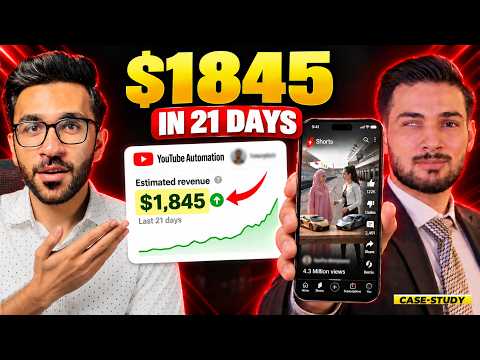
This Guy Secretly Runs 100 Faceless YouTube Channels and Has Made Over $100,000 From Them! CaseStudy
Published
Should I watch this?
Skip to the real contentYour full summary is ready below. Read on while we finish your watch recommendation.
Your summary is ready. The watch recommendation is next.
Worth watchingSkim
The AI-script and CapCut walkthrough provides concrete production steps, but repeated pitches dilute the payoff, while the promised 100-channel case study lacks operational depth and glosses over copying, copyright, and monetization risks.
The main answer
The video explains how to produce faceless YouTube videos without recording your own face or voice. Its example is celebrity-history content aimed at older US viewers, chosen for potentially higher advertising revenue. The workflow shown is: find a competitor’s successful video, copy its topic and title, feed its transcript into an AI tool apparently identified as Claude, generate a replacement script, create an AI voiceover, and edit in CapCut. The demonstration retains competitors’ video clips while replacing their photos with images downloaded through Google. Thumbnails are also copied and minimally altered in Canva. This is a practical demonstration of fast content replication—not a proven, reliably profitable business formula. Changing narration, photos, or colors does not automatically make copied material original, lawful, or eligible for YouTube monetization.
Key takeaways
- The guest says a team operates 100-plus channels. Despite the introduction’s emphasis on one person managing them, this is not a solo operation.
- For beginners, he suggests allowing five to six months to reach monetization. Claims of monetizing within days are presented as exceptional outcomes, not dependable timelines.
- His preferred niche covers older American celebrities across entertainment and sports. The claim that older viewers watch more advertisements and generate better revenue is not substantiated in the transcript.
- He reports that 18–25-minute videos perform best and that his team uploads three videos daily per channel. These are descriptions of his operation, not established recommendations for everyone.
- He claims production takes 20–25 minutes per video for his experienced team, versus roughly 60–90 minutes for a beginner. Research, fact-checking, licensing, and quality-control work are largely absent from the demonstration.
- Reported figures include roughly $3–$4 overall RPM, $500-plus monthly revenue for average channels, $1,000-plus for the top celebrity channel, and approximately $100,000 in a peak month across the operation. These figures are not independently verified or clearly reconciled; salaries and other costs mean revenue is not profit.
- The main risks are copyright infringement, reused or repetitive content affecting monetization, and inaccurate AI-generated celebrity stories. The host’s suggestion that this is fair use is not a sufficient legal assessment.
Summary
Host Saad interviews Aqib about scaling faceless YouTube channels through team-based production, competitor research, AI scripts, synthetic narration, and quick editing. The video provides a concrete workflow but relies heavily on copying competitors and largely skips rights clearance, factual verification, expenses, and failure rates. Educational segments are interspersed with paid mentorship and voiceover-tool promotions.
What’s being promoted?
The clearest commercial promotion is the host’s “Advanced YouTube Automation Mentorship Program.” He says it can help viewers earn their first dollar within 90 days and includes guidance, support, a community, and a senior team. Viewers are asked to contact his WhatsApp sales team with a screenshot to receive a claimed 50% discount and bonuses. The transcript does not establish the normal price, refund terms, student success rate, or whether the discount is genuinely limited. The 90-day pitch also sits alongside the guest’s more cautious five-to-six-month beginner estimate. A voiceover service transcribed as “Speak se” is strongly promoted through an upcoming birthday deal, a lifetime-plan promise, and limited-availability language. The host says the service’s team told him about a special offer for his audience, suggesting a promotional relationship. However, sponsorship, affiliate commissions, and exact usage limits are not disclosed in the transcript. Its precise brand identity is uncertain because of transcription quality; unlimited lifelong usage should not be assumed. WhatsApp is the main audience and sales funnel: competitor links, the script prompt, tool-deal announcements, and mentorship contact are repeatedly routed there. Free resources give viewers a reason to join, where further marketing can occur. Claude, CapCut, Canva, Google, and optionally ChatGPT are primarily presented as workflow tools; no paid relationship with them is established. Named example channels serve as benchmarks, with ownership or commercial ties unspecified. The creator therefore appears to have an additional agenda beyond instruction: selling mentorship, building a reachable WhatsApp audience, promoting a voiceover offer, and increasing channel engagement. Repeated sales calls, discount urgency, income-focused framing, and requests for likes and comments support that interpretation. This does not establish deception or prove the earnings are false, but it creates incentives to emphasize attractive outcomes over costs, risks, and unsuccessful attempts.