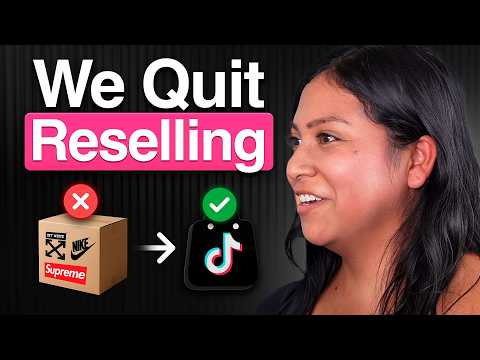
She Failed Every Final Because Her Phone Was Making $50,000 a Month
Published
Should I watch this?
Skip to the real contentYour full summary is ready below. Read on while we finish your watch recommendation.
Your summary is ready. The watch recommendation is next.
Worth watchingSkim
Skim the teeth-whitening and drink-video breakdowns for concrete lessons on hooks, on-camera demonstrations, and tight editing; much of the rest is repetitive college-dropout motivation, lifestyle discussion, and course promotion.
The main answer
Alexis Stein says she earns about $30,000 a month through TikTok Shop affiliate commissions: she posts product videos and receives a commission when viewers buy through them. She claims $50,000 in her first month, roughly $400,000 in cumulative earnings, and $2.5–$2.7 million in merchandise sales. Those sales are not her personal income, and none of these figures is independently verified in the transcript. Her practical strategy is to choose visually demonstrable products, study successful videos, open with a strong hook, demonstrate the product immediately, use tight editing, and repeat successful formats with fresh angles. She recommends understanding the product thoroughly and making one or two strong videos rather than posting indiscriminately. This is not a demonstrated formula for reliably earning $30,000 monthly. She acknowledges getting unusually lucky initially, says her second month fell to approximately $17,000, and reports two bans related to weight-management claims.
Key takeaways
- Choose products that create an immediate visual demonstration and address a recognizable customer concern.
- Study successful hooks and formats, then develop original angles rather than endlessly copying identical videos.
- Product knowledge, clear demonstrations, movement, and tight editing are her main repeatable production lessons.
- Her marketing deliberately provokes insecurities about teeth, appearance, and weight. That may attract attention, but it raises ethical concerns and has led to platform enforcement.
- The opening emphasizes ten-minute production and exceptional income; the full interview describes research, editing, sustained effort, and community support. It is not simply effortless passive income.
- She separates commission-focused affiliate accounts from a personal brand intended to build loyalty and support future product launches.
- Her earnings figures do not establish typical results, after-tax take-home pay, or fully documented business profit. The transcript provides no representative success or failure rates.
- Leaving college is her personal decision, not a conclusion supported for viewers generally. Her story includes academic difficulties and little interest in engineering before the business succeeded.
Summary
The interview follows a 21-year-old who says an unexpectedly successful TikTok Shop launch led her to leave engineering studies, move to Miami, and fund a condiment startup. It mixes useful short-video marketing advice with motivational claims about confidence, environment, and entrepreneurship. The host celebrates the success story but does little to challenge the financial figures, health assertions, or broader claims about college and business risk.
What’s being promoted?
The clearest sales pitch is the host’s Shop House membership. Viewers are told to click Join for additional guest interviews containing their “exact blueprint” and “exact playbook.” Calling it the “one and only subscription” needed and guaranteeing it will be viewers’ best purchase are strong promotional claims, not substantiated findings. The interview supplies an inspiring success story while reserving supposedly fuller instruction for paying members. Media Labs receives repeated, enthusiastic endorsements. Alexis credits its community, scripts, product recommendations, and support with helping her succeed, and recommends joining it to beginners. This functions as a testimonial. The transcript does not establish whether the host or guest receives referral fees, has ownership interests, or was paid for these mentions. It also provides no course price, typical student outcomes, or evidence that purchasing training is necessary. Alexis also promotes her unnamed condiment startup, describing mayonnaise, ranch, and garlic aioli, existing preorders, and planned December shipping. Her personal story and audience-building advice support that launch. She explicitly values loyal followers because they make future launches easier and describes luxury-car content as a marketing tactic—evidence that lifestyle presentation serves a commercial purpose alongside any genuine enjoyment. Her claims that competing avocado oils are fraudulent or cause inflammation and insulin resistance are unsupported in the transcript. They also position her forthcoming products as healthier alternatives. Her explanation of the oil formulation is unclear, so neither the proposed ingredients nor the claimed health advantage can be confidently assessed from this interview. Snow whitening pens, Leafar cutting mix, and Medicube masks receive favorable exposure as past affiliate winners. Her general commission incentive is explicit, but payment for these particular podcast mentions is not disclosed. Reusing a celebrity’s endorsement also raises permission and misleading-association questions; saying the videos received no violation does not establish authorization. Overall, this is both an interview and a marketing vehicle: the host sells membership, Media Labs gains prospective customers, and Alexis gains followers and potential condiment buyers. That commercial agenda is evident; undisclosed sponsorships, coordinated promotion, or fabricated earnings are not established. The main concern is the framing: exceptional results, luxury imagery, and criticism of conventional education make the opportunity appear more broadly attainable than the evidence supports.