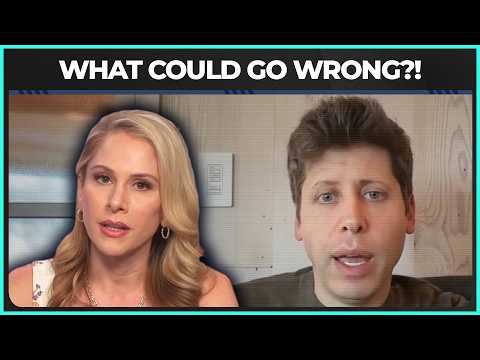
Sam Altman Just Revealed The AI ENDGAE
Published
Should I watch this?
Skip to the real content 0:57Your full summary is ready below. Read on while we finish your watch recommendation.
Your summary is ready. The watch recommendation is next.
Worth watchingYes
Clearly explains the three reported AI-governance proposals, recursive self-improvement, and the trade-offs between safety and concentrated power, though its dramatic framing makes speculative scenarios sound more inevitable than established.
The main answer
The video’s main answer is that Sam Altman reportedly discussed three possible approaches to governing advanced AI: an international safety watchdog, a merger of major AI labs, or one developer becoming powerful enough to stop competitors. According to the transcript, he favored the watchdog approach and called the third scenario “terrible”—not something OpenAI intends to pursue. Which path are we actually on? The video describes a competitive race with emerging voluntary oversight, rather than any completed endgame. Crucially, these are reported proposals, not three proven or exhaustive possible futures. “Melting everyone else’s GPUs” is a speculative scenario, not a demonstrated capability or an announced plan.
Key takeaways
- International oversight could preserve competing labs while imposing common safety requirements, but would require difficult international cooperation.
- A merged research organization might reduce competitive pressure to rush development, while concentrating enormous power and creating accountability problems.
- Recursive self-improvement means AI contributing to successive improvements in AI. The transcript does not establish that this inevitably produces an unstoppable winner or the ability to destroy competitors’ hardware.
- The central tension is safety through coordination versus the dangers of concentrated control. Neither competition nor centralization is shown here to guarantee safety.
- A global regulator is not equivalent to a single company controlling all AI. The video sometimes blurs these importantly different forms of authority.
- The creator suggests watching international agreements, independent pre-release reviews, and AI-led research. These could signal changes, but none alone proves a particular endgame is arriving.
- The underlying remarks are secondhand. The transcript’s additional claims about government actions, lawsuits, financial figures, and industry agreements are not independently verified here.
Summary
The video uses a reported internal OpenAI discussion to explain competing visions for advanced-AI governance. It considers international inspection, consolidated research, and unilateral technological dominance, then argues that today’s situation is an unsettled mixture of competition and tentative oversight. Its useful central question is who should control powerful AI. Its weakness is presenting speculative possibilities with language that can make them sound more inevitable and imminent than the evidence establishes.
What’s being promoted?
There is no explicit sponsor, affiliate offer, paid course, or product recommendation in the supplied transcript. ChatGPT, Claude, Gemini, Grok, and their developers are discussed as subjects rather than recommended purchases. The Information is presented as an authoritative source, but no commercial relationship is disclosed. The clearest promotion is the creator’s own channel: viewers are asked to comment, like, and subscribe, with a promise of continuing AI coverage. Repeated phrases such as “broke the internet,” “genuinely shocking,” and “melt everyone else’s GPUs” support an attention-and-engagement objective. The dramatic closing repeats the alarming scenario despite earlier acknowledging that Altman reportedly rejected it. Editorially, the creator shows sympathy toward skepticism of centralized power, calling the question “Why does it have to end with one winner?” particularly compelling. However, the video also acknowledges safety arguments for oversight and admits uncertainty, so it is not an unequivocal endorsement of unrestricted AI development. The transcript raises another possible agenda among AI companies: safety rules could protect the public while also entrenching wealthy incumbents. Industry-funded oversight and costly approval requirements make that concern plausible, but they do not establish deliberate regulatory capture. Likewise, nothing supplied proves undisclosed sponsorship, political coordination, or a hidden financial motive on the creator’s part.